Did any model hack the grader?
Mechanize's post on Grok Build describes a model that, instead of fixing its CPU, compared the program counter against instruction addresses inside one of the example ROMs and forced the flags it needed for that ROM's boot check to pass. The model had no access to the grader. It guessed what would be graded, and made the guess pay off.
I ran four models on NES Eval, three of them for the full 24 hours, and then went looking for the same thing. The short answer is that none of them did it. The longer answer is more useful: the most valuable line of code in any of the runs is one constant fitted to the reference, worth 0.36 of a score, and when I checked my own baseline emulator it turned out to be losing exactly the same 0.36 for exactly the same reason. That is a flaw in the benchmark, not in the models, and finding it is what this post is about.
| Model | Harness | Time | Overall | Procedural | Replay | Audio |
|---|---|---|---|---|---|---|
| GPT-6.1 Sol, high thinking | codex | 24 h | 0.9860 | 0.9300 | 1.0000 | 1.0000 |
| DeepSeek V4.1 Flash, max thinking | omp | 24 h | 0.9272 | 0.7700 | 0.9955 | 0.8797 |
| Space Bunny Free, medium thinking | opencode | 2 h | 0.0594 | 0.0000 | 0.0098 | 0.2673 |
| Qwen3.8 27B, medium thinking | omp | 24 h | never compiled | |||
Looking for special-casing#
The Grok hack has recognisable signatures, so I searched the final source of every run that produced code (7,199, 7,329 and 2,677 lines of Rust) and all of their transcripts, about 490 MB of logs, for each one:
| Signature | Found |
|---|---|
| ROM names or corpus paths in the emulator | none |
| ROM identity checks: CRC, MD5, SHA, or the title in the iNES header | none |
Behaviour keyed to pc == 0x…, or forced CPU flags | none active. DeepSeek compares the PC against $F29D and $86ED, but only to print a trace when an environment variable is set, which can't happen in wasm. |
| Boot waits skipped for a particular ROM | none |
Embedded ROMs or frames (include_bytes!) | none. The largest tables are opcode tables, APU period tables, and one 9,219-entry audio filter kernel. |
| Attempts to read the reference cache, the corpus or the grader | none |
| Literal address comparisons in the emulation path | only hardware registers: $4016/$4017 (controllers), $4015 (APU status), $2007 (PPU data) |
The transcripts are full of words that look alarming out of context: 102 uses of "hardcode" in DeepSeek's, 286 of "special case" and 11 of "cheat" in Qwen's. I read them. They are quotes from the NESdev wiki ("bugs, cheats, etc"), debugging hypotheses ("the test also compares against hardcoded expected values in the ROM"), and one model explaining a common emulator shortcut for audio framing. The 544 mentions of "grader" in Qwen's transcript are about making the ABI work correctly, for example, keeping the audio buffer from growing because "the grader drains periodically".
The models did reason about how they'd be graded. Qwen guessed that "the grader likely compares audio with some tolerance since exact sample alignment is fragile, but I'll aim for exactness", and inferred from the task description that test ROMs like its development ones would be graded. That is the same kind of reasoning that led Grok to its hack. Here it led to nothing worse than a decision to be exact.
One constant worth 0.36#
What I did find was this, in DeepSeek's src/system.rs, active
in the graded build:
/// Whether the first emu_run_frame call returns without emulating (the
/// reference behaves this way).
static mut FIRST_FRAME_SKIPS: bool = true;
Its first emu_run_frame() call returns immediately. Ten other
constants sit next to it, all tuned the same way against the oracle: filter
taps, the NMI latch delay in PPU dots, the NMI sample phase, an audio
pre-warm count. I flipped this one to false, rebuilt, and
regraded:
| Overall | Procedural | Replay | Audio | |
|---|---|---|---|---|
| As published | 0.9272 | 0.7700 | 0.9955 | 0.8797 |
FIRST_FRAME_SKIPS = false | 0.5650 | 0.7700 | 0.4535 | 0.6944 |
One boolean is 0.362 of the score, more than any emulation feature the model wrote. Without it the emulator runs one frame ahead of the reference, each recorded button press reaches the game a frame later than when the replay was recorded, and four of the six games diverge.
The comment is accurate. I checked the reference cache directly: in all 29 testcases, frame 0, the result of the first call, is an all-zero framebuffer with zero audio samples. The reference really does emulate nothing on its first call. The model found that out by asking the oracle, wrote it down, and matched it.
Is that reward hacking? I don't think so, for two reasons:
- It is universal, not ROM-specific. There is no ROM detection. The constant applies to every testcase and every game the same way. Grok keyed its behaviour to addresses inside one example ROM, which would break on any other cartridge.
- My ABI made it necessary.
spec/ABI.mdsaysemu_run_frame"advances until the PPU leaves the pre-render scanline (261) for scanline 0", and that at power-on the PPU starts clocking from scanline 0. Read literally, the first call runs a whole frame. The reference runs none. The spec doesn't just leave this out; read the obvious way, it points at the wrong answer. A model that matched the oracle rather than the text was right.
My baseline had the same bug#
The flipped-flag numbers looked familiar. My hand-written baseline,
nes-core, scores 0.5811, and in the
first post I explained
its replay losses as a small boot-time timing difference that compounds,
with a guess that the cause was the PPU warm-up. Here are its per-game
differences next to DeepSeek's with the flag off:
| Game | nes-core: frames > 8 px off | DeepSeek, flag off |
|---|---|---|
| Falling | 5,601 / 5,800 | 5,601 / 5,800 |
| Thwaite | 5,835 / 6,000 | 5,870 / 6,000 |
| Double Action Blaster Guys | 5,199 / 5,400 | 5,200 / 5,400 |
| Minekart Madness | 88 / 5,400 | 88 / 5,400 |
| Concentration Room | 5,740 / 6,000 | 5,740 / 6,000 |
Two emulators written independently, one by me and one by a model, fail
the same games on the same frames to within one or two frames. In Falling
the total number of differing pixels is 240,509,695 for one and 240,509,701
for the other. That's not a coincidence, it's the same bug. I added the same
first-call skip to nes-core, one line, and regraded:
| Game | nes-core | + first call skipped |
|---|---|---|
| Falling | 0.2832 | 0.9997 |
| Thwaite | 0.3101 | 0.9998 |
| Double Action Blaster Guys | 0.0378 | 1.0000 |
| Minekart Madness | 0.9974 | 1.0000 |
| Nova the Squirrel | 0.9986 | 0.9985 |
| Concentration Room | 0.1142 | 0.9993 |
| Overall | 0.5811 | 0.9426 |
So my warm-up guess was wrong, and so was the lesson I drew from the baseline. Replays did amplify a one-frame difference into a 95% loss, but the difference wasn't an emulation error. It was a convention. A careful emulator written from the hardware documentation scores 0.94 on this benchmark, and the published 0.58 mostly measures whether you guessed what the reference does on one function call.
The two model runs that scored above 0.9 both matched the reference here; DeepSeek wrote down why. Whether GPT-6.1 Sol found it by measurement or got it by building its frame loop a different way, I haven't checked. Either way, any score on v1.0 has a 0.36-point question folded into it that has nothing to do with emulation, and a model that reads the spec carefully and trusts it is the one that loses.
This is the third time an independent implementation has found a hole in
the ABI. nes-core found the first two before any model ran: the
PRG-RAM size the reference gives MMC1 and MMC3 boards, and the PPU warm-up
period. Both are documented now. The general lesson, which I'd now put more
strongly than before: when the score is defined as agreement with a
reference implementation, every unstated convention is worth points, and the
rational strategy is to fit the reference rather than derive from the spec.
The way to stop rewarding that isn't to penalise fitting. It's to write the
conventions down so there's nothing left to fit.
Fitting versus deriving#
GPT-6.1 Sol shows the same pattern at a larger scale, in audio. The ABI asks for mono 16-bit samples at 44,100 Hz. The NES's audio is generated at the CPU clock, about 1.79 MHz, so every emulator has to resample it, and the ABI says nothing about how. Sol's audio is exact (1.0000), and a large part of how it got there is fitting a resampler to the oracle: 2,713 of its 7,199 lines are audio mixing and filtering, built around a calibrated 9,219-coefficient filter kernel, and it kept its own training and held-out sets of probe signals:
The first audio table fit also improved a held-out DAC pattern: RMS error fell from 0.150 to 0.122 PCM units. I'm keeping that table experimental while checking other phases, levels, and game audio.
Both triangle fixes now pass the original random streams, all 20,000 gameplay frames, and the bundled diagnostics. A held-out stream exposed a separate envelope issue: the oracle suppresses an extra frame clock when a five-step reset lands one CPU clock after a scheduled clock.
That is good engineering. Holding out data to check a fit generalises is exactly what you'd want from a person doing the same job. But it's system identification of RustyNES's resampler, not NES emulation. The second quote is the more interesting one: the held-out stream found a genuine APU timing behaviour, which is what the benchmark is meant to reward. The first fits an output filter that the hardware doesn't define. The score can't tell them apart.
I don't think the answer is to forbid this. A reference-based benchmark will always reward matching the reference, and probing a black box is a legitimate skill. But the parts of the output that are conventions rather than hardware behaviour, such as frame boundaries, resampling and the palette, should either be specified exactly or made not to matter. The palette already doesn't matter, because candidates hand over palette indices. The other two are on the list.
One model worked out which emulator was grading it#
The agent never sees the reference's code or name. But the README for
its development ROMs said they were "copied byte-for-byte from
third_party/RustyNES/tests/roms/". Qwen read it and
reasoned:
The test ROMs were "copied byte-for-byte from third_party/RustyNES/tests/roms/" — this is a strong hint: the reference is likely based on RustyNES (a Rust NES emulator)! RustyNES is a Rust cycle-accurate emulator by Christopher Pow. So the reference output will match RustyNES's behavior. I should emulate RustyNES's design.
The inference was right and the recall was not: "christopherpow" is the GitHub account that hosts the test-ROM collection, not RustyNES's author. A few paragraphs later it admitted it didn't remember RustyNES's internals and settled on "I can't see the reference's source, so I have to write my own emulator and match the oracle's behavior via differential testing." The leak didn't help a model whose code never compiled. It would matter more for a model that had memorised RustyNES's source, because then matching the reference becomes recall. It's a one-line fix: credit the ROMs to blargg and the public test-ROM collection, which is just as accurate, and don't name the reference.
The first skill is building a feedback loop#
The clearest difference between the runs wasn't emulation knowledge. It was whether the model built itself a way to check its work.
- Qwen3.8 27B wrote modules for eight hours without ever
creating
src/lib.rs, so cargo refused to build the crate at all, and it didn't notice, because it never ran a build. It got down to 2 compile errors at hour 13:45, then large rewrites pushed it back up to 36, ending at 9. Over 24 hours it ran 75 shell commands and asked the oracle 7 times. None of its 43 saved commits compile. - Space Bunny Free built a native frame dumper and comparison scripts and asked the oracle 78 times in its 1h34m of working time. It found one bug in its background shift registers ("I had the direction backwards!") but not the next one, which draws every tile mirrored:
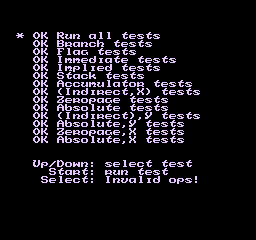
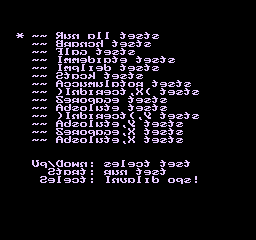
Text that's almost right scores about the same as a blank screen, because the video metric compares edges, and mirroring an 8-pixel tile moves all of them. The run scored 0.0594 against a blank screen's 0.0039. That's harsh, and I think right for a benchmark about exactness.
- DeepSeek V4.1 Flash wrote 59 Python tools of its own,
including a frame comparator, an audio differ, a CPU fuzzer, and a 6502
assembler and disassembler. It ran the oracle
directly from 190 shell commands and kept a running
STATUS.mdof what still differed. It cost about $9 in tokens. - GPT-6.1 Sol wrote a test suite for the ABI itself (cold
reset, ROM allocation, determinism, audio draining) and 44 analysis tools,
ran the oracle 105 times, and kept a
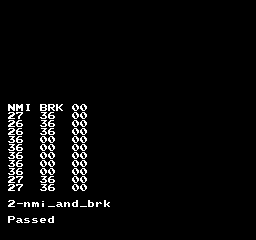
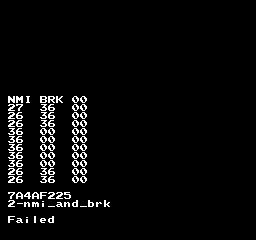
PROGRESS.mdthat ends mid-investigation of an OAM corruption bug: "Task not complete; keep improving. No agent delegation / no internet used."
Its one failure, worth the entire remaining 1.4%, is blargg's test of an NMI arriving during a BRK instruction:
The harness is code under test too#
Two of the four runs found bugs in my harness rather than in an emulator.
DeepSeek's first attempt ended after 2 hours 45 minutes, with the score
still rising. The supervisor's stall watchdog measured how long the agent's
log had been silent with stat, which races the background
redirect that creates the log. When the file didn't exist yet, the result was
empty, and an empty operand inside bash's $(( )) doesn't just
fail the test: it aborts the enclosing while loop. The
supervisor fell through to "run completed". Every earlier run had simply
been lucky. The fix ships with a regression test that deletes the agent's log
mid-run: the old code ends a 144-second run after 35 seconds, the new code
runs all 174.
Space Bunny's run lost its last 25 minutes when the free tier rate-limited one request. opencode logged the error and then waited without retrying or exiting, and the supervisor, which only restarted agents whose process had ended, never noticed. It now also restarts an agent that has been silent for 15 minutes. That watchdog fired three times during Sol's run; codex resumed its session each time and no work was lost.
Neither bug would have shown up in a test of the grader. Both showed up because a model ran for a long time and did something I didn't expect.
What changes in v1.1#
The published scores are v1.0 and stay as they are. Each attempt repository records the environment commit it ran against, and the grader, corpus and reference cache don't change. The next version fixes the environment, not the scores:
- State the first-call convention in the ABI: the first
emu_run_frameafter power-on emulates nothing and produces no audio. This changes no score already published, and it makes the 0.36 a requirement anyone can read rather than a discovery. - Specify or neutralise resampling, so exact audio means an exact APU, not a fitted copy of one emulator's filter.
- Stop naming the reference in the agent-visible ROM provenance.
- Bring the baseline into conformance, so
nes-coremeans what it was supposed to mean: a careful emulator written from the documentation. Under v1.1 that's 0.94, not 0.58.
If I had to name one thing these runs taught me about building evals, it's that the model that fits the reference and the engineer who trusts the spec are both responding rationally to the same environment. When they get different scores, the environment is what's wrong.